

CNC FIT GUIDE · PUBLISHED 14 AUGUST 2026
How to determine whether a CNC machine will fit in your shop.
A reliable fit review separates the machine envelope from the facility envelope, compares placement, operation, service and rigging, and refuses to hide uncertain inputs behind a convincing 3D view.
Start with the exact machine configuration
The same CNC model can have different conveyors, controls, spindle options, automation, pallet systems, transformers and guarding. Confirm the supplied layout drawing, units, revision and orientation. For a used machine, document field modifications and accessories separately.
If a STEP model is available, confirm that it represents the purchased configuration. A simplified model may omit doors, service-removal paths and accessories that determine the real fit.
Build the complete working envelope
Separate the shipping footprint, installed footprint, operating envelope, service envelope and maintenance-removal envelope. Add operator positions, loading access, material handling, chip and coolant handling, guarding and utility connections.
- Placement: can the installed configuration occupy the destination?
- Operation: can people and material use it safely and efficiently?
- Service: can panels, doors and removal paths be accessed?
- Rigging: can the shipping configuration reach and orient at the destination?
Compare options before locking the layout
Align the machine information with the captured facility where the data is suitable and placement is in scope. Compare alternate orientations and positions against columns, walls, equipment, aisles, operator flow and service zones.
The purpose is to find weak assumptions early and focus controlled site checks on the few clearances that matter most—not to create false precision from incomplete inputs.
Frequently asked questions
Can a 3D model prove that a CNC machine fits?
Only if both the equipment and facility information are suitable for the required tolerance and critical conditions are independently verified. A visual placement alone is not proof.
Which dimensions should be independently verified?
Every clearance that could stop the move, prevent installation, compromise operation or service, or create a safety or compliance problem.
Why use mobile SLAM LiDAR?
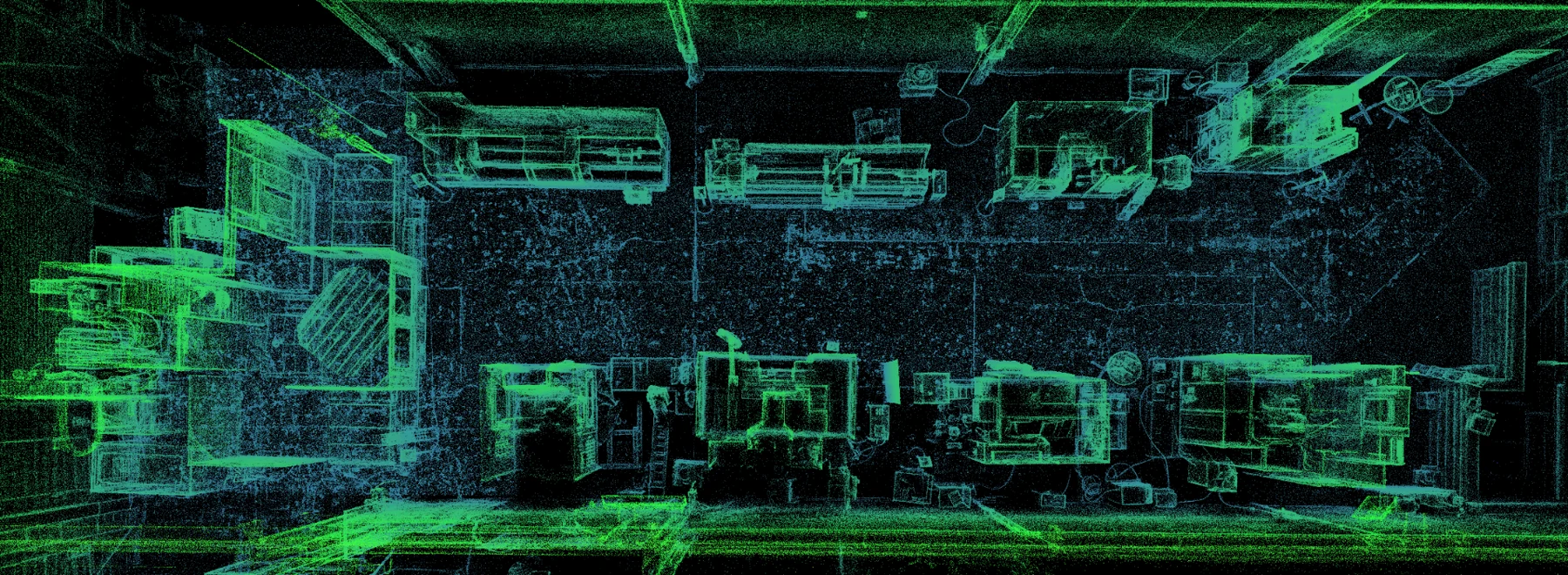
It efficiently records broad facility context while the operator walks. The resulting point cloud is useful for planning, but route, environment, loop closure, surfaces and drift must be considered.
START WITH THE FACILITY DECISION
Bring the real plant into the CNC planning conversation.
Axial Spaces captures planning-grade mobile SLAM LiDAR context and builds browser-ready facility views for manufacturers across Southern Ontario.
Scope My Facility Project