

Account for the actual configuration
Include the chip conveyor, coolant system, bar feeder, transformer, pallet equipment, control cabinets and other accessories that travel with the used machine.
USED CNC · PURCHASE REVIEW · RELOCATION PLANNING
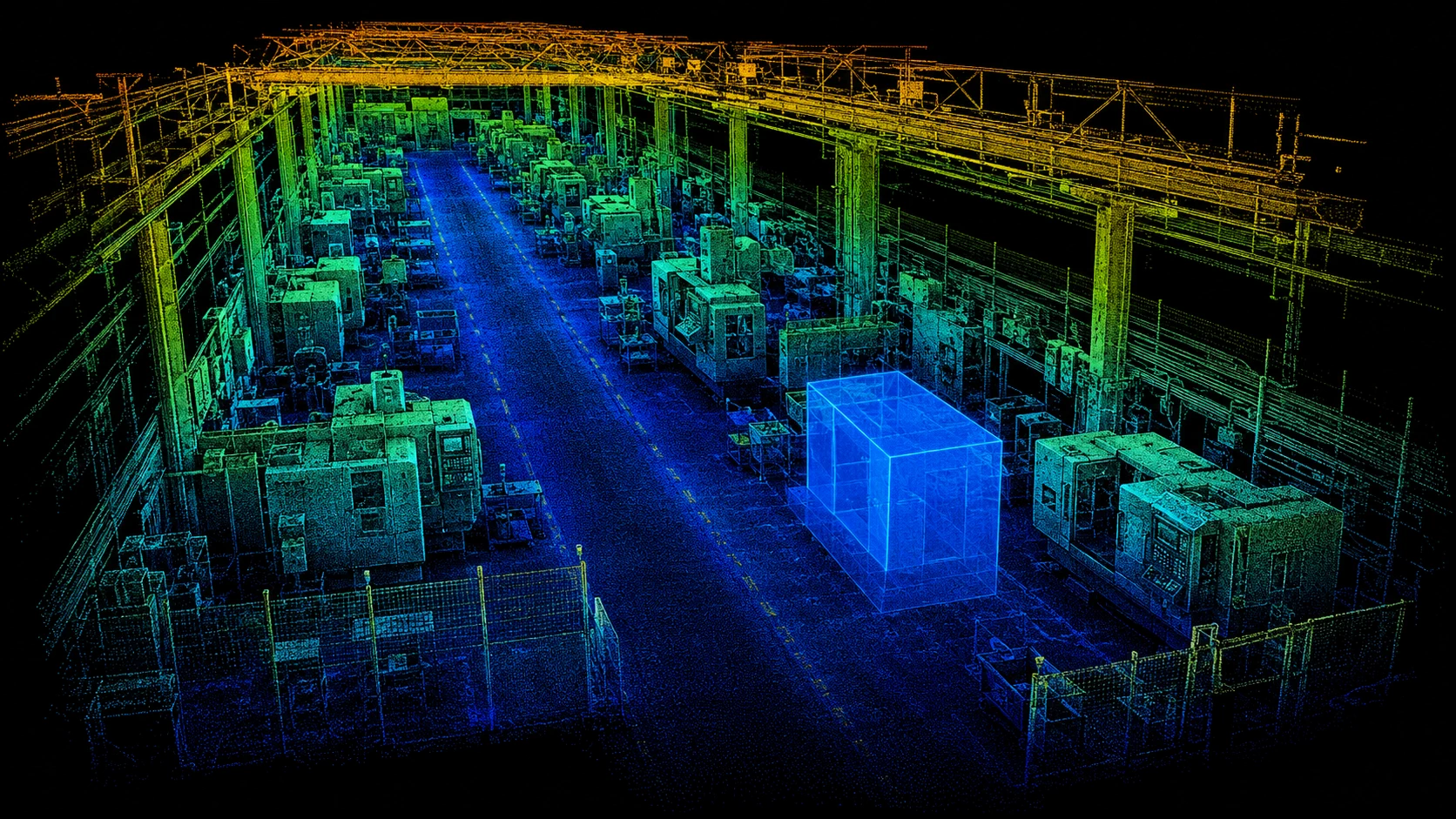
A used CNC arrives with a specific configuration, accessories and installation history. Axial Spaces uses planning-grade mobile SLAM LiDAR facility context to help compare the destination, move route, working envelope and information gaps before the purchase or relocation becomes expensive to unwind.
WHAT YOUR TEAM GAINS
Include the chip conveyor, coolant system, bar feeder, transformer, pallet equipment, control cabinets and other accessories that travel with the used machine.
Compare available drawings and seller information with the proposed plant location, then identify the dimensions, utilities and service zones that still need confirmation.
Give the purchaser, seller, machine dealer, rigger, trades and plant team one shared view of the route and final location.
A used CNC lathe, machining centre, grinder, EDM or boring mill arrives with a configuration shaped by its previous plant. Conveyor direction, bar-feeder length, guarding, transformers, coolant equipment and field modifications can make a nominal model footprint misleading.
Use the exact serial-specific documentation and a physical inspection whenever possible. A facility twin supports the comparison; it cannot determine machine condition or confirm undocumented modifications.
A low purchase price can be erased by access problems, unexpected building work, service changes, rigging constraints or production disruption. Reviewing the destination early gives the buyer a clearer list of questions for the seller, dealer and installation team.
The objective is not to create false certainty. It is to make uncertainty visible while there is still time to negotiate, choose another location or walk away.
Gather serial-specific drawings, current accessories, shipping configuration, service requirements and seller-supplied information.
Confirm what will be removed for shipping, what will travel separately, and what must be reinstalled or verified at the destination.
HOW A PROJECT MOVES
Collect the serial-specific machine information, accessories, shipping condition, utilities and seller evidence.
Record the proposed route, destination and surrounding plant with a planned mobile SLAM LiDAR route.
Evaluate the current machine envelope against the planning-grade facility context and alternate orientations.
Assign missing dimensions, inspections, quotations and professional reviews before the purchase or move proceeds.
STRAIGHT ANSWERS
Available seller information and field observations can support an early review, but missing or uncertain machine dimensions must be resolved before a fit decision. The scan cannot make incomplete machine data reliable.
No. Mechanical, electrical, control and geometric condition require the appropriate machine-tool inspection specialists. Axial Spaces focuses on the facility, route, placement and shared planning context.
No blanket metrology- or survey-grade claim is made. It is planning-grade context, with result quality influenced by route, environment, loop closure, surfaces and drift. Critical dimensions require controlled independent verification.
Yes, when they are included in the capture and project scope. The team can compare likely placement, access, workflow and surrounding constraints before selecting the location for detailed verification.
START WITH ONE REAL FACILITY
Focused decision-capture projects start around CAD $1,500. Full-facility capture, facility twins, equipment-move planning, hosting, and specialized deliverables are quoted by scope.
Scope My Facility Project